Wednesday, 14 February 2018

Didgeridoo Tribe Cartoon Gallery by Soukou


In those good old days of the online Didgeridoo Tribe (see bottom of the page for a sample forum discussion), tribe member Soukou posted a set of cartoons featuring many of the well known members of the tribe.  I am now providing here a good home for these cartoons:


Big Toach


Dreadhead


Dreamweaver


Erkl1


Finch


Frostman


Gonewalkabout


Kellymon


Larry Iwan


Moondrop


Pandoroo


Pumpkinman


 Soukou


Stan


Woody

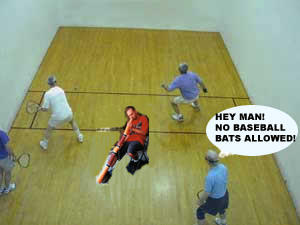
After seeing this last one I felt I had to do a Soukou Cartoon of my own featuring Soukou in his appropriately named and acoustically preferred playing area: a "racketball" court!


Best wishes to the great Soukou!
 While searching through the archives I also found a few pages I had saved from the original Didgeridoo Tribe Forum.  I thought the following one on nicknames was appropriate here:

Even More Interesting Sounds: Tongue Droning


Tongue Droning

Here is an interesting technique I have been working on: tongue droning where you stick out your tongue between your lips and produce the drone by vibrating your tongue INSTEAD of your lips. While this technique is easier to do with front blowing, it can also be done while side blowing. Here is a sample mp3 with alternating lip and tongue drones using my wooden Australian tourister didge in F:


I'm sure many people do tongue droning without realizing it. The easiest way is to stick out your tongue and do a "Teeeeeeeeeeeee" but without using the vocal chords, just as a mouth shape. You start to feel the vibrations transferring from your lips to your tongue, and your tongue tingles.

A drawn out "te" as in "tender" seems to work somewhat better than "tee" as in "tea". You can hear this on my above sound sample, which is played on my first didge, by the way. This one was bought for me in Australia by my friend and band mate, Jethro, who hauled it all around Australia with him. It is an inexpensive one, just a straight cyclinder made from some kind of wood and with paintings of a emu and a platypus on it. I found this one difficult to learn on, but I do play it now from time and time, and enjoy it's sound, particularly when tongue droning.

Here is a sample of some tongue droning effects on my high G didge:

More Interesting Sounds: Drooting

Drooting

As well as intooting, I am working these days to improve my regular tooting. I have found there is a range of toots LOWER in pitch than the first overtone and that require less breath and a looser lip action (halfway between droning and trumpeting) to play. In fact, if you blow too hard, you just end up with the first overtone. These are ideal to use for working on circular breathing during long toots.

Since the lip action is halfway between droning and tooting, I call this technique drooting.

I like these droots on my pseudoconical in D because they allow me to toot the note an octave above the basic drone. My first overtone is an F. These lower range droots actually span the octave note: the strongest ones are at the octave note as well a note above and a note below. Vocalizations also come across better with these lower range droots. You seem to be able to droot a note an octave above the basic drone on any sort of didge. I tried it on all mine, though it may be difficult to side blow these droots. I front blow them.

Here is a sample sound file that starts with a drone, then a trumpet toot at the first overtone, then come the droots, an octave above the drone and a note above and below this. This sample concludes with alternating drones and droots at the note an octave above the basic drone:


Here's another drooting sound file example. This one droots the tune Mary Had a Little Lamb which is essentially the same tune as Merrily We Roll Along:


This was drooted on my ABS pseudoconical didge in D and recorded using Quartz Studio Free.

Another fun tune to droot is the Ode to Joy theme from Beethoven's Ninth Symphony. Vocalizations go very well with this one.

Here is a spectrum analysis of the droot and the drone. The top spectrum shows the basic D drone coming in as the large mountain on the left. Below that is the droot which comes in strongly at the D an octave above the drone:


Interesting Sounds: Intooting

Inhale Tooting

Before I learned to circular breathe I used to toot while taking in a breath THROUGH THE MOUTH. It was a desperate alternative. I gave it up after I learned to circular breathe, but it is an interesting technique that I call Intooting.

Here's a little example of some intake toots (and an intake pop). Great way to hyperventilate:  

Here's another example that is fuller in sound and closer to the first overtone:

Both these examples were recorded with Quartz Studio Free using my ABS Pseudoconical Didge in D.

This might explain why sometimes it's hard to detect a player's circular breathing. Maybe they aren't circular breathing at all, but breathing in during a toot!

Intoot Technique: loosen your lips, curve them inward JUST SLIGHTLY around your teeth, exhale deeply and as you inhale draw your lips closer together till you find the sweet spot. Without the didge it sounds a bit like someone rubbing a balloon or a balloon letting some air out. Try to take long, slow breaths in and out so you have plenty of inhalation to experiment with. With practice, you can intoot without deep inhaling. In learning to intoot you will pass through the following stages:

    1. Whimpering Wombat: little or no sound and wandering

         about in the dark.
    2. Sick Elephant: heart rending sick elephant sounds combined 

        with crazed kisses goodbye.
    3. Angry Emu: lots of short uncontrollable emu sounding toots.
    4. Intooters Anonymous: too late to turn back now!  You're      

        making great sounding toots and drones and are totally 
        hooked.

The great thing about intooting is that you do not have to attempt to circular breathe while tooting. You can do a series of toots and catch a breath by making some of them intoots.

Intooting is handy for those times when you've blown yourself into a corner and don't have enough air left to circular breathe. This seems to happen from time to time, especially if you are using the tongue piston method of circular breathing or are bounce breathing from the diaphram.

Since intooting involves taking air in through the mouth, it is not recommended if there is a build up of dust and debris in your didge. Intooting does not require much intake of air. When practicing you should not be straining your lungs!

Here's a fun little example of using intoots to echo drone rhythms:


Here are the spectrums for a toot and an intoot at the first overtone on my D didge: 


I thought that there might be some differences, particularly in the harmonics they pick up, but they are virtually identical.

Here is a sound sample of alternating toots and intoots:

Tuesday, 6 February 2018

Tsamiko: My First Didgeridoo Recording

Here is my first didgeridoo recording:  Tsamiko. 


This recording was made using a tsamiko style midi drum loop loaded down from Goodwin Free Midi Drum Files.  I don't believe Goodwin drum tracks are available anymore.  But it is possible to find many other free drum tracks.  The Smart Hobby Musican Blog has a great list of free drum tracks:
 – sorted by genre and tempo

Tsamiko is a popular traditional folk dance of Greece, done in 3/4 time.  It seemed to me to sound like a good basis for didgeridoo.  It is fun to play didge using the variety of rhythms to avoid falling into a rhythmic rut.  There was a point where I seemed to be continually slipping into an annoying macarena rhythm.  Free drum tracks are a fun way to try many different rhythms.  

A bass track and then a didgeridoo track were added. The didgeridoo used in this recording was my ABS sectional in the key of D.

Monday, 5 February 2018

Bass Sectional ABS Didgeridoo (Key of G)

 I made my first bass didge in G from 1 inch diameter pipe, thinking that the smaller diameter pipe would require less wind. But that one ended up being about twelve feet long! It didn't sound good, but was good for comic relief, especially since it tended to fall apart.  The kids at the library thought it was pretty hilarious.

My next attempt was a straight sectional using 2 inch pipe. It was about six feet long and sounded good, but also tended to fall apart. So I decided to reduce the length as they do with modern trumpets by using two u-joints. This one came out sounding just as good or better than the straight model. 

An added benefit of the curves was that the playing end ended up closer to the bell end, so that you could hear quite well what was coming out. I have found that for most long, straight didges, the sound the player hears can be quite different from the sound the audience hears coming out the other end!

Here is a sound sample of my original bass didge in G (Warning: It may knock your house down!)


The new model uses 1 inch and 1.5 inch diameter pipe at the blowing end to increase the back pressure and make it easier to play. This didge is therefore also more conical in shape, which improves the sound.

 This didge toots a C at the first overtone and a G at the second.

The U joints are used to reduce the overall length to something manageable and less unwieldy. You swivel the segments around into something like a trombone configuration. 


Once you get used to the amount of wind required and the much looser lip vibration, bass didges are lots of fun to play and quite different.

One great thing about the bass didge is that it's quite easy to blow a range of three toots or trumpet tones. By good fortune the three toots on my ABS bass didge in G ended up being C G & D, all notes that fall nicely into the key of G:


Toots on most didges I've played start sounding very strained when you get above the second one, but since the bass didge is so low, it is not a strain to toot three levels at least. The lip action for these toots is so loose they are essentially drones, therefore you can actually say you have four didges in one!  Here's a brief sound sample of a bass rhythm I'm working on using the first two toots and some high harmonics:


High harmonics on a bass didge are quite low! This sample will test out the bass response of your computer speakers as well!

Converting the Sectional Didge into a Tuneable Didgibone


Here is an easy way to convert an ABS sectional didge into a tuneable didgibone, like a slide trombone, hence the name. This involves removing the seating rim inside an ABS connector, so that the smaller pipe is free to slide in and out: 


In the above diagram, section 3 becomes the sliding pipe. If you cut section 3 to a length of 22 inches then you have a sliding didge that goes from the key of C up to the key of F.

At the moment I am leaving the slide section with a very tight fit, so that it doesn't shift around once it is the length you want. For slide didge effects it would be necessary to sand down the inside of the connector further so that section 3 can slide more freely. I haven't done that yet because I am mainly interested in having a didge that can quicky change key, and that stays in place when the required key is found. Once you have used a tuner to establish the key lengths you can etch a marker line onto the outside of the pipe.

My sectional didge in D toots an F. An interesting advantage of the sectional didgibone is that when you increase the length of the sliding pipe to 31 inches you can set the key to D and find yourself tooting in D as well. This is the first ABS didge I've ever made that can actually toot (or trumpet play) the same key note (an octave up), at least for the key of D. The second toot is an F# which also falls happily into the key of D. I have tried for a long time to get an ABS didge that toots the same note (an octave up) as the basic drone.


Sectional ABS Didgeridoo Using Four Different Diameter Pipes (Key of F)

This didge is the first one I've made that uses FOUR different diameters of pipe. It drones in F and also toots in F...which makes me...